The history of computers is a remarkable journey that spans thousands of years. From simple counting tools used by ancient civilizations to today’s Artificial Intelligence systems, computers have evolved to become an essential part of modern life. Understanding this evolution helps us appreciate how technology has transformed society and continues to shape our future.
Learning Objectives
- Understand the origins of computing devices.
- Learn about important inventors and innovations.
- Explore the five generations of computers.
- Understand how computing technology evolved over time.
- Recognize the impact of computers on modern society.
Early Computing Devices
Long before electronic computers existed, humans used various tools to perform calculations. These devices laid the foundation for modern computing.
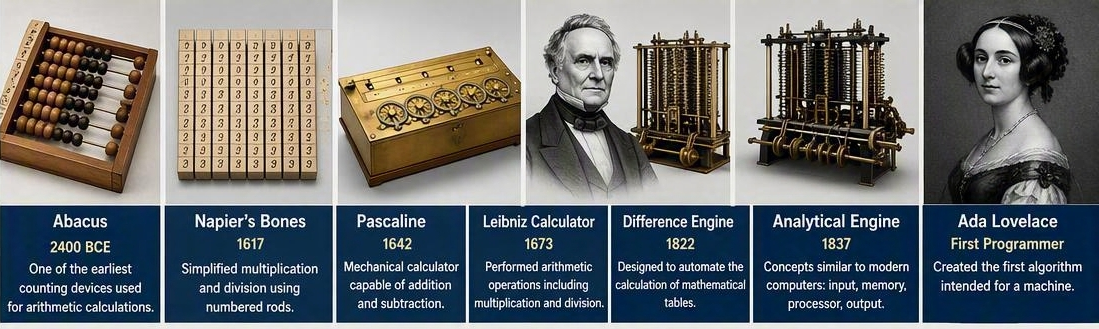
The Abacus (2400 BCE)
The Abacus is considered one of the earliest calculating devices. It was used for addition, subtraction, multiplication, and division calculations.
- Used beads mounted on rods
- Popular in ancient China and Mesopotamia
- Improved the speed and accuracy of calculations
Napier’s Bones (1617)
Invented by Scottish mathematician John Napier, this device simplified multiplication and division using numbered rods.
Pascaline (1642)
Blaise Pascal developed the Pascaline, one of the first mechanical calculators capable of performing addition and subtraction.
Leibniz Calculator (1673)
Gottfried Wilhelm Leibniz improved mechanical calculation by creating a device capable of multiplication and division.
The Birth of Modern Computing
Charles Babbage and the Difference Engine
In 1822, Charles Babbage designed the Difference Engine, a machine capable of automatically performing mathematical calculations.
Charles Babbage is widely known as the Father of the Computer.
The Analytical Engine (1837)
Babbage later designed the Analytical Engine, a machine with concepts similar to modern computers.
- Input Unit
- Processing Unit
- Memory Storage
- Output Unit
Ada Lovelace
Ada Lovelace worked with Babbage and developed the first algorithm intended for a machine.
Ada Lovelace is recognized as the world’s first computer programmer.
Hollerith and Data Processing
Herman Hollerith
In 1890, Herman Hollerith developed punched card technology to process census data faster and more efficiently.
His innovations later contributed to the company that became IBM (International Business Machines).
Features
- Stored information using punched cards.
- Significantly reduced processing time.
Impact
His company eventually became part of:
International Business Machines (IBM)
The Electronic Computer Age
The 20th century marked the transition from mechanical to electronic computing.
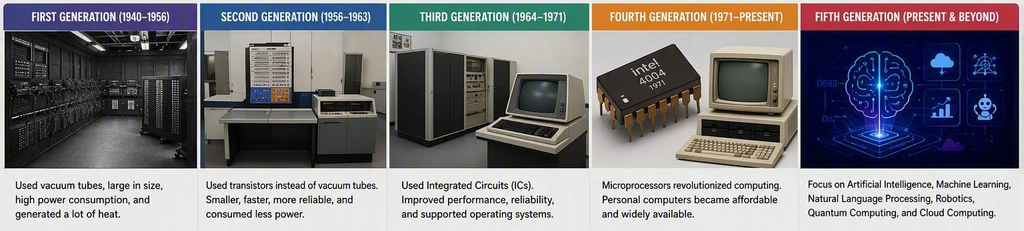
First Generation Computers (1940–1956)
The first generation of computers used vacuum tubes for processing data.
- Very large size
- High power consumption
- Produced excessive heat
- Expensive to maintain
Examples
- ENIAC
- UNIVAC I
Second Generation Computers (1956–1963)
Transistors replaced vacuum tubes, making computers smaller, faster, and more reliable.
- Reduced power consumption
- Improved performance
- Greater reliability
- Lower maintenance costs
Popular programming languages such as FORTRAN and COBOL emerged during this era.
Third Generation Computers (1964–1971)
The introduction of Integrated Circuits (ICs) significantly improved computer performance.
- Smaller computers
- Faster processing
- Improved reliability
- Support for operating systems
Examples
- IBM System/360
- PDP-8
Fourth Generation Computers (1971–Present)
The invention of the microprocessor revolutionized the computer industry.
Intel 4004
Released in 1971, the Intel 4004 was the first commercially available microprocessor.
- Enabled personal computers
- Reduced system size
- Increased processing power
Personal Computer Era
- Apple II
- IBM PC
- Microsoft Windows
Computers became affordable and accessible to homes, schools, and businesses.
Fifth Generation Computers (Present and Beyond)
Artificial Intelligence Era
Fifth-generation computing focuses on intelligent systems powered by Artificial Intelligence and Machine Learning.
Technologies
Artificial Intelligence (AI)
Examples:
- ChatGPT
- Copilot
- Virtual Assistants
Machine Learning
Computers learn from data without explicit programming.
Robotics
Used in:
- Manufacturing
- Healthcare
- Transportation
Natural Language Processing
Allows computers to understand human language.
Examples:
- Voice Assistants
- Chatbots
Quantum Computing
A future technology capable of solving highly complex problems.
Companies involved include:
- IBM
- Microsoft
Major Milestones in Computer History
| Year | Innovation |
|---|---|
| 2400 BCE | Abacus |
| 1617 | Napier’s Bones |
| 1642 | Pascaline |
| 1822 | Difference Engine |
| 1837 | Analytical Engine |
| 1890 | Punched Cards |
| 1945 | ENIAC |
| 1951 | UNIVAC I |
| 1971 | Intel 4004 |
| 1981 | IBM PC |
| Today | AI and Cloud Computing |
Impact of Computers on Society
Education
- Online learning
- Virtual classrooms
- Digital libraries
Business
- Automation
- Data analysis
- E-commerce
Banking
- ATM services
- Mobile banking
- Online transactions
Healthcare
- Electronic medical records
- Telemedicine
Government
- E-governance
- Digital public services
Key Takeaways
- The Abacus was one of the earliest computing devices.
- Charles Babbage is known as the Father of the Computer.
- Ada Lovelace is considered the first programmer.
- Computers evolved through five generations.
- Vacuum tubes, transistors, integrated circuits, and microprocessors drove major technological advancements.
- Microprocessors enabled the personal computer revolution.
- Modern computing focuses on Artificial Intelligence (AI), Machine Learning, cloud computing, automation, and Quantum Computing.
Knowledge Check
- Who is known as the Father of the Computer?
- What was the purpose of the Analytical Engine?
- Which technology replaced vacuum tubes?
- What is a microprocessor?
- Name three technologies associated with fifth-generation computers.
Quiz
1. Who is known as the Father of the Computer?
A. Alan Turing
B. Charles Babbage ✅
C. Herman Hollerith
D. John Napier
2. Which generation used vacuum tubes?
A. First Generation ✅
B. Second Generation
C. Third Generation
D. Fourth Generation
3. What replaced vacuum tubes?
A. ICs
B. Microprocessors
C. Transistors ✅
D. AI
4. Who is considered the first programmer?
A. Ada Lovelace ✅
B. Grace Hopper
C. Blaise Pascal
D. Alan Turing
5. Which generation focuses on AI?
A. Second
B. Third
C. Fourth
D. Fifth ✅
Summary
The evolution of computers reflects humanity’s constant pursuit of faster, more accurate, and more intelligent ways to process information. From the Abacus to Artificial Intelligence, each technological breakthrough has contributed to the digital world we live in today.
One thought on “History and Evolution of Computer Technology”