Introduction
Grace Hopper was one of the most influential figures in the history of computing. A mathematician, computer scientist, and United States Navy officer, she helped transform computers from complex machines requiring specialized knowledge into tools that could be programmed using human-readable languages.
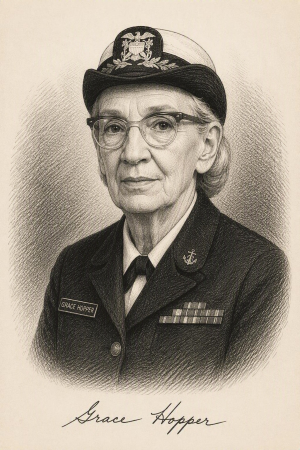
Her groundbreaking work on compilers and programming languages changed software development forever, earning her the title “Pioneer of Programming Languages.”
Today, many of the concepts used in modern software engineering can be traced back to Grace Hopper’s vision and innovation.
Early Life and Education
Grace Brewster Murray Hopper was born on December 9, 1906, in New York City, United States.
From an early age, she showed curiosity about how machines worked. According to family stories, she often dismantled household clocks to understand their mechanisms.
Hopper pursued higher education in mathematics and physics, earning a bachelor’s degree from Vassar College and later a master’s degree and doctorate in mathematics from Yale University.
Her strong mathematical background would become the foundation of her pioneering work in computing.
Joining the World of Computing
During World War II, Hopper joined the United States Navy Reserve.
She was assigned to work on the Harvard Mark I, one of the earliest large-scale electromechanical computers.
The Mark I performed calculations much faster than humans and was used for military and scientific applications.
Working with this machine gave Hopper firsthand experience with the challenges of programming early computers.
The Problem with Early Programming
In the early days of computing, programmers had to write instructions using machine code, a language consisting of numerical commands understood only by computers.
This process was difficult, time-consuming, and prone to errors.
Grace Hopper believed there should be a better way.
She envisioned a system in which programmers could write instructions using words and logical statements rather than machine-specific codes.
Inventing the First Compiler
One of Hopper’s greatest achievements was the creation of the first compiler.
What Is a Compiler?
A compiler is software that translates programming language instructions into machine code that a computer can execute.
Today, compilers are essential tools for languages such as:
When Hopper proposed the idea, many computer experts believed it was impossible.
Despite skepticism, she successfully developed one of the first compiler systems and demonstrated that computers could translate human-friendly commands into machine instructions.
This innovation revolutionized software development.
The Development of COBOL
Grace Hopper played a major role in creating COBOL (Common Business-Oriented Language).
COBOL was designed to resemble everyday English and make programming accessible to more people.
Why COBOL Was Important
Before COBOL:
- Programs were difficult to write.
- Systems were hardware-dependent.
- Business applications were complicated to develop.
COBOL introduced:
- Readable syntax
- Business-oriented programming
- Greater software portability
- Easier maintenance
For decades, COBOL became one of the most widely used programming languages in government, banking, finance, and enterprise systems.
Many financial institutions still use COBOL applications today.
The Origin of the Term “Bug”
Grace Hopper is often associated with the popular computer term “bug.”
While investigating a malfunction in an early computer, engineers discovered an actual moth trapped inside the machine.
The insect was removed, and the incident was recorded in the system log.
Although the term “bug” existed before computers, Hopper helped popularize the practice of identifying and “debugging” software and hardware problems.
Today, debugging is a fundamental part of software development.
Leadership and Recognition
Throughout her career, Hopper became a respected leader in technology and the military.
She encouraged innovation and challenged traditional thinking.
Her ability to explain complex technical ideas made her a powerful advocate for computer science education.
She received numerous awards and honors for her contributions to computing and programming.
Legacy
Grace Hopper’s vision fundamentally changed the way people interact with computers.
Lasting Contributions
- Developed one of the first computer compilers
- Advanced the development of programming languages
- Contributed to COBOL
- Promoted standardized software development
- Inspired future generations of programmers
Many universities, research institutions, and technology organizations continue to celebrate her work.
The annual Grace Hopper Celebration, one of the world’s largest technology conferences, honors her contributions and legacy.
Grace Hopper at a Glance
Full Name: Grace Brewster Murray Hopper
Born: December 9, 1906
Birthplace: New York City, United States
Died: January 1, 1992
Nationality: American
Profession: Computer Scientist, Mathematician, Naval Officer
Known For: First Compiler, COBOL Development
Title: Pioneer of Programming Languages
Famous Quote
“The most dangerous phrase in the language is: ‘We’ve always done it this way.'”
— Grace Hopper
Why Grace Hopper Matters Today
Modern software development depends heavily on programming languages, compilers, and standardized coding practices.
Without Grace Hopper’s innovations, programming would likely remain far more complex and inaccessible.
Her belief that computers should be easier to use helped shape the modern software industry and paved the way for today’s developers.
Conclusion
Grace Hopper transformed computer programming through innovation, leadership, and determination. By creating the first compiler and helping develop COBOL, she made software development more accessible and efficient. Her work continues to influence programming languages, software engineering, and computer science education around the world.
Grace Hopper’s legacy serves as an inspiration to everyone seeking to use technology to solve problems and improve society.
4 thoughts on “Grace Hopper: Pioneer of Programming Languages”