Introduction
Tim Berners-Lee is best known as the inventor of the World Wide Web, one of the most important technological innovations in modern history. His groundbreaking work transformed the internet from a specialized research network into a global platform for communication, education, business, and innovation.
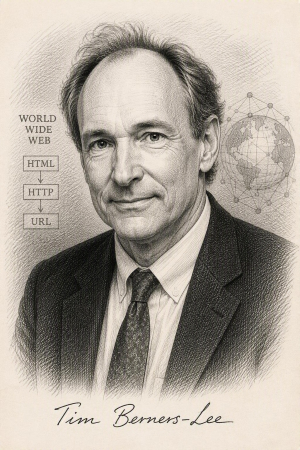
Today, billions of people use the web daily to access information, connect with others, and conduct business. None of this would have been possible without the vision and creativity of Tim Berners-Lee.
Early Life and Education
Timothy John Berners-Lee was born on June 8, 1955, in London, England.
His parents were computer scientists who worked on some of the earliest commercial computers. Growing up in an environment that encouraged curiosity and problem-solving, Berners-Lee developed a strong interest in technology and electronics.
He later studied physics at The Queen’s College, Oxford University, where he gained valuable technical and analytical skills that would contribute to his future achievements.
The Internet Before the Web
Before the World Wide Web existed, the internet was already being used by researchers, universities, and government organizations.
However, accessing information was often difficult because data was stored on different systems that were not easily connected. Users needed specialized knowledge to find and retrieve information.
Berners-Lee recognized the need for a simpler way to share information across computers and networks.
Creating the World Wide Web
A Revolutionary Idea
In 1989, while working at CERN, the European Organization for Nuclear Research, Tim Berners-Lee proposed a system that would allow documents to be linked and accessed over the internet.
His goal was to help researchers share information more efficiently.
This proposal eventually became the World Wide Web (WWW).
The Three Core Technologies
To make the web possible, Berners-Lee developed several key technologies that remain essential today.
HTML (HyperText Markup Language)
HTML provides the structure for web pages by organizing content such as text, images, and links.
HTTP (HyperText Transfer Protocol)
HTTP enables communication between web browsers and web servers.
URL (Uniform Resource Locator)
URLs provide unique addresses that allow users to locate specific resources on the web.
Together, these technologies established the foundation for the modern web.
The First Website
In 1991, Tim Berners-Lee launched the world’s first website.
The site explained what the World Wide Web was and how people could create their own web pages and servers.
Although simple by today’s standards, this website marked the beginning of a digital revolution that continues to shape society.
The First Web Browser
Berners-Lee also developed the first web browser and web editor.
This software allowed users to:
- Browse web pages
- Create content
- Access linked documents
- Share information across networks
These capabilities became the basis for modern browsers like Microsoft Edge, Google Chrome, Firefox, and Safari.
Why the World Wide Web Changed the World
The World Wide Web dramatically changed how information is shared and accessed.
Major Impacts
Education
Students can access educational materials from across the globe.
Communication
People can communicate instantly through websites, email, and online services.
Business
Companies can promote products, provide services, and reach customers worldwide.
Research
Researchers can share discoveries and collaborate internationally.
Entertainment
Music, videos, games, and digital media became widely accessible through the web.
The web created opportunities that transformed nearly every aspect of modern life.
Keeping the Web Open
Unlike many inventors, Tim Berners-Lee did not patent the World Wide Web.
Instead, he encouraged open standards that allowed developers and organizations worldwide to adopt and expand the technology freely.
This decision played a significant role in the rapid growth and success of the web.
The World Wide Web Consortium (W3C)
In 1994, Berners-Lee founded the World Wide Web Consortium (W3C).
The organization’s mission is to develop and maintain standards that ensure the web remains accessible, interoperable, and open.
Many modern web standards continue to be developed through W3C.
Legacy
Tim Berners-Lee’s contribution to technology is difficult to overstate.
Lasting Contributions
- Invented the World Wide Web
- Created HTML
- Developed HTTP
- Designed the URL system
- Built the first web browser
- Promoted open web standards
- Helped connect billions of people worldwide
His innovations laid the groundwork for today’s digital economy and information society.
Tim Berners-Lee at a Glance
Full Name: Sir Timothy John Berners-Lee
Born: June 8, 1955
Birthplace: London, England
Nationality: British
Profession: Computer Scientist
Known For: Inventing the World Wide Web
Organization: World Wide Web Consortium (W3C)
Title: Inventor of the World Wide Web
Famous Quote
“The Web does not just connect machines, it connects people.”
— Tim Berners-Lee
Why Tim Berners-Lee Matters Today
Modern society depends heavily on the World Wide Web. From online learning and social media to e-commerce and cloud services, nearly every digital experience relies on technologies pioneered by Tim Berners-Lee.
His commitment to openness and accessibility continues to influence the future of the internet and digital communication.
Conclusion
Tim Berners-Lee revolutionized the world by inventing the World Wide Web. Through the creation of HTML, HTTP, URLs, and the first web browser, he made information sharing more accessible than ever before. His vision transformed the internet into a global platform that empowers education, business, communication, and innovation.
As the inventor of the World Wide Web, Tim Berners-Lee remains one of the most influential technology pioneers of all time.
2 thoughts on “Tim Berners-Lee: Inventor of the World Wide Web”