Introduction
Dennis Ritchie was one of the most influential computer scientists in history. Best known as the creator of the C programming language and co-developer of the Unix operating system, his work laid the foundation for modern software development and operating systems.
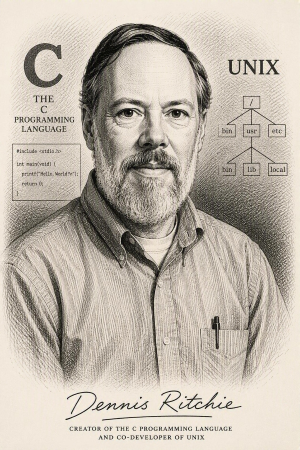
Many of today’s technologies, including operating systems, databases, programming languages, and embedded devices, trace their origins to innovations introduced by Dennis Ritchie.
His contributions continue to power computers, smartphones, servers, and internet infrastructure around the world.
Early Life and Education
Dennis MacAlistair Ritchie was born on September 9, 1941, in Bronxville, New York, United States.
He developed an early interest in mathematics and science and later attended Harvard University, where he studied physics and applied mathematics.
After completing his education, Ritchie joined Bell Labs, a world-renowned research institution that became the birthplace of many important technological innovations.
Working at Bell Labs
Bell Labs provided an environment where researchers could explore new computing technologies.
While working there, Dennis Ritchie collaborated with fellow computer scientist Ken Thompson on several groundbreaking projects that would influence computing for decades.
Their most famous achievements were the development of Unix and the creation of the C programming language.
The Birth of Unix
Creating a New Operating System
In the late 1960s and early 1970s, computers were becoming more powerful, but operating systems were often complex and difficult to use.
Dennis Ritchie and Ken Thompson worked together to create Unix, a flexible and efficient operating system.
Why Unix Was Revolutionary
Unix introduced important concepts such as:
- Multi-user computing
- Multitasking
- File-based architecture
- Portable software development
- Modular system design
These ideas influenced nearly every modern operating system.
Today, operating systems such as Linux, macOS, Android, and many server platforms are inspired by Unix principles.
Creating the C Programming Language
A Language That Changed Computing
While developing Unix, Dennis Ritchie recognized the need for a powerful yet efficient programming language.
In the early 1970s, he created the C programming language.
C combined the speed of low-level programming with the flexibility of higher-level languages.
This balance made it ideal for operating system development and software engineering.
Features of the C Language
The C language introduced many features that helped it become one of the most successful programming languages ever created.
Key Advantages
- High performance
- Efficient memory management
- Portability across hardware platforms
- Structured programming capabilities
- Flexibility for system-level development
Because of these strengths, C remains widely used today.
Influence on Modern Programming
The impact of C extends far beyond its original purpose.
Many popular programming languages were inspired directly by C, including:
Even programmers who never write C often use languages that inherit its syntax and design principles.
Unix and C: A Powerful Combination
One of Ritchie’s greatest achievements was rewriting Unix using the C programming language.
This decision made Unix far more portable than other operating systems of its time.
Instead of being tied to a single computer model, Unix could be adapted to various hardware platforms.
This innovation accelerated the spread of Unix across universities, research centers, and businesses worldwide.
Lasting Impact on Technology
Dennis Ritchie’s work continues to influence modern computing.
Technologies Influenced by Ritchie
Operating Systems
Linux, macOS, Android, BSD, and many enterprise systems build upon Unix concepts.
Programming Languages
Numerous programming languages borrow features from C.
Embedded Systems
Many devices use software written in C because of its performance and efficiency.
Internet Infrastructure
Servers, databases, and networking technologies often rely on C-based software.
Awards and Recognition
Throughout his career, Dennis Ritchie received numerous honors for his contributions to computer science.
His achievements were recognized by universities, technology organizations, and scientific communities around the world.
Today, he is widely regarded as one of the most important software pioneers in history.
Legacy
Dennis Ritchie’s contributions helped shape the digital age.
Lasting Contributions
- Created the C programming language
- Co-developed the Unix operating system
- Advanced software portability
- Influenced modern programming languages
- Shaped operating system design
- Supported the growth of modern computing
His innovations continue to power billions of devices globally.
Dennis Ritchie at a Glance
Full Name: Dennis MacAlistair Ritchie
Born: September 9, 1941
Birthplace: Bronxville, New York, United States
Died: October 12, 2011
Nationality: American
Profession: Computer Scientist
Known For: C Programming Language and Unix
Title: Creator of the C Programming Language
Famous Quote
“Unix is basically a simple operating system, but you have to be a genius to understand the simplicity.”
— Dennis Ritchie
Why Dennis Ritchie Matters Today
Every day, people use technologies influenced by Dennis Ritchie’s work. From smartphones and web servers to cloud infrastructure and software applications, the concepts he introduced remain essential to modern computing.
Without Unix and C, the technology landscape would look very different.
His contributions continue to inspire programmers, engineers, and computer scientists around the world.
Conclusion
Dennis Ritchie revolutionized software development through the creation of the C programming language and co-development of the Unix operating system. His innovations established many of the principles that still guide modern computing today.
As one of the true pioneers of computer science, Dennis Ritchie’s legacy lives on in the software, systems, and technologies that power the digital world.
One thought on “Dennis Ritchie: Creator of the C Programming Language”