Introduction
When discussing the origins of modern computing, one name stands above all others: Charles Babbage. Known as the Father of the Computer, Babbage was a mathematician, inventor, philosopher, and mechanical engineer whose visionary ideas transformed the future of technology.
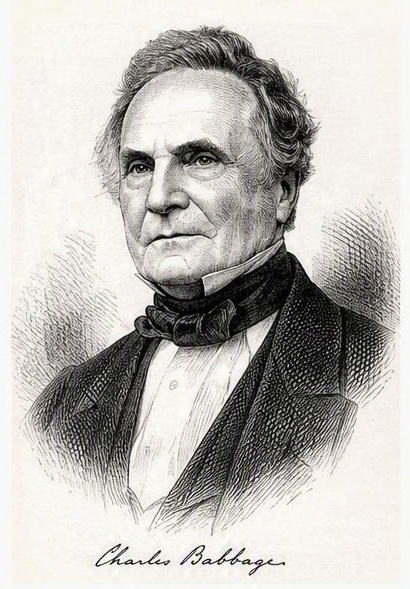
More than a century before electronic computers became a reality, Babbage designed machines capable of automatically performing calculations and processing data. His revolutionary concepts introduced many of the principles that are still used in modern computers today.
Early Life and Education
Charles Babbage was born on 26 December 1791 in London, England. From an early age, he demonstrated exceptional talent in mathematics and scientific reasoning.
He pursued higher education at Trinity College, Cambridge, where he became deeply interested in mathematics and the accuracy of scientific calculations. During this period, many mathematical tables contained errors because they were calculated manually, causing serious problems for scientists, engineers, and navigators.
Babbage believed that machines could eliminate these mistakes and improve accuracy, leading him to begin work on automatic calculating devices.
The Difference Engine
Solving Mathematical Errors
In the early nineteenth century, mathematical tables were essential for navigation, astronomy, and engineering. Errors in these tables often produced costly and dangerous consequences.
To address this problem, Babbage designed the Difference Engine, a mechanical calculator intended to automatically generate mathematical tables.
Features of the Difference Engine
- Automatic calculation of mathematical functions
- Reduced human errors
- Mechanical gear-driven operation
- Automated printing of results
- Improved accuracy and efficiency
The Difference Engine represented a major breakthrough in computational technology and demonstrated that machines could be used to perform complex calculations reliably.
The Analytical Engine
The World’s First Computer Design
After developing the Difference Engine, Babbage conceived an even more advanced machine known as the Analytical Engine.
The Analytical Engine is widely considered the first design for a general-purpose programmable computer.
Although it was never completed during his lifetime, its architecture closely resembles today’s computers.
Major Components
The Mill
The Mill functioned as the processing unit and performed calculations, similar to a modern CPU.
The Store
The Store acted as memory, holding numbers and instructions for processing.
Input and Output
The machine would use punched cards to receive instructions and produce printed outputs.
Control Mechanisms
The Analytical Engine could perform loops and conditional operations, concepts still used in modern programming languages.
Why It Was Revolutionary
The machine introduced ideas that form the foundation of computer architecture:
- Memory storage
- Central processing
- Program execution
- Input and output systems
- Conditional branching
- Repetitive loops
These features make the Analytical Engine one of the most remarkable inventions in technological history.
Collaboration with Ada Lovelace
Charles Babbage worked closely with Ada Lovelace, who is recognized as the world’s first computer programmer.
Lovelace studied the Analytical Engine and produced extensive notes describing how it could be programmed to perform various operations.
Her work included an algorithm designed specifically for the Analytical Engine, making it the first known computer program.
Together, Babbage and Lovelace established many of the theoretical foundations of modern computing and software development.
Challenges and Setbacks
Despite his innovative ideas, Babbage faced numerous obstacles.
Major Challenges
- Limited manufacturing technology
- High production costs
- Inadequate government funding
- Mechanical complexity
- Political disagreements over project funding
These factors prevented the complete construction of the Analytical Engine during his lifetime.
Other Contributions
While best known for computing innovations, Babbage made important contributions in several other fields.
Mathematics
Published influential mathematical research and numerical analysis techniques.
Engineering
Improved precision manufacturing methods and mechanical design.
Economics
Studied industrial processes and workforce productivity.
Cryptography
Researched methods related to coded communications and security.
Transportation
Investigated railway engineering and safety systems.
Legacy and Impact
Charles Babbage’s ideas were far ahead of their time. Although he never completed a fully functioning computer, his concepts directly influenced later generations of engineers and scientists.
Today, every computer contains principles that originated in Babbage’s designs.
Lasting Contributions
- Designed the first programmable computer concept
- Introduced memory and processor architecture
- Inspired modern computer engineering
- Influenced software development principles
- Established foundations of computational thinking
His vision continues to shape the digital world, from smartphones and laptops to artificial intelligence and cloud computing.
Charles Babbage at a Glance
Personal Information
Full Name: Charles Babbage
Born: 26 December 1791
Birthplace: London, England
Died: 18 October 1871
Nationality: British
Profession: Mathematician, Inventor, Mechanical Engineer
Known For: Difference Engine and Analytical Engine
Title: Father of the Computer
Famous Quote
“I wish to God these calculations had been executed by steam.”
— Charles Babbage
Conclusion
Charles Babbage was one of history’s greatest innovators. His designs for the Difference Engine and Analytical Engine introduced concepts that would eventually become the foundation of modern computing. Though the technology of his time prevented his machines from being fully realized, his vision transformed the future and earned him the title Father of the Computer.
Today, every digital device owes a debt to the pioneering ideas of Charles Babbage.
6 thoughts on “Charles Babbage: The Father of the Computer”