Introduction
Ada Lovelace is celebrated as the world’s first computer programmer. At a time when computers did not yet exist, she recognized the potential of Charles Babbage‘s Analytical Engine and envisioned how machines could perform far more than mathematical calculations.
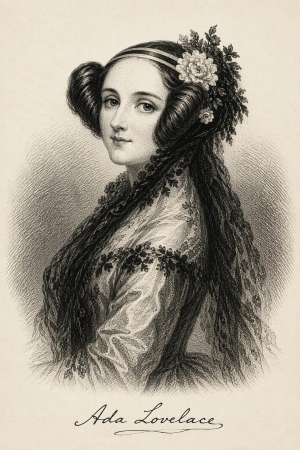
Her groundbreaking work laid the foundation for modern computer programming and earned her a place among the most influential pioneers in technology history.
Early Life
Ada Lovelace was born Augusta Ada Byron on December 10, 1815, in London, England. She was the daughter of the famous poet Lord Byron and Annabella Milbanke, who encouraged her interest in mathematics and science.
Unlike many women of her era, Ada received an extensive education in mathematics. She developed a passion for analytical thinking and mechanical inventions from a young age.
Meeting Charles Babbage
In 1833, Ada met Charles Babbage, the mathematician who designed the Difference Engine and later the Analytical Engine.
Babbage recognized Ada’s exceptional intellect and introduced her to his revolutionary ideas about computing machines.
Their collaboration would become one of the most important partnerships in the history of computing.
Understanding the Analytical Engine
The Analytical Engine was a proposed mechanical computer capable of performing complex calculations automatically.
While studying Babbage’s design, Ada realized that the machine could process more than numbers. She suggested that a computer could potentially manipulate symbols, create music, and solve problems according to programmed instructions.
This idea was revolutionary because it anticipated the capabilities of modern computers more than a century before they existed.
The First Computer Program
Ada Lovelace translated an article about the Analytical Engine written by Italian engineer Luigi Menabrea.
She added extensive notes that were significantly longer than the original article. In these notes, Ada described a method for calculating Bernoulli Numbers using the Analytical Engine.
This algorithm is widely recognized as the first computer program ever written, making Ada Lovelace the first computer programmer.
Why This Was Important
Ada’s algorithm introduced concepts that remain fundamental to programming:
- Sequential instructions
- Data processing
- Repetitive operations
- Logical procedures
- Machine-executed algorithms
Ada’s Vision of Modern Computing
Perhaps Lovelace’s greatest achievement was her understanding of what computers could become.
While many people thought computing machines would only perform calculations, Ada believed machines could process various forms of information.
She wrote that a machine might someday compose music, create graphics, and assist in scientific work.
Today, computers perform exactly these functions, demonstrating how far ahead of her time Ada Lovelace truly was.
Challenges as a Woman in Science
Ada pursued mathematics during a period when women had very limited opportunities in scientific fields.
Despite social barriers and restrictions on women’s education, she earned respect among scholars and mathematicians through her intelligence and dedication.
Her success made her one of the earliest female figures in computer science and technology.
Legacy
Ada Lovelace’s contributions were not fully appreciated during her lifetime. However, as computing developed in the twentieth century, historians recognized the profound significance of her work.
Today, she is remembered for:
- Writing the first computer algorithm
- Foreseeing the future of computing
- Advancing computational theory
- Inspiring women in technology
- Influencing modern computer science
The programming language ADA, developed by the United States Department of Defense, was named in her honor.
Ada Lovelace at a Glance
Full Name: Augusta Ada King, Countess of Lovelace
Known As: Ada Lovelace
Born: December 10, 1815
Birthplace: London, England
Died: November 27, 1852
Nationality: British
Profession: Mathematician and Writer
Known For: First Computer Program
Title: World’s First Computer Programmer
Famous Quote
“The Analytical Engine weaves algebraic patterns just as the Jacquard loom weaves flowers and leaves.”
— Ada Lovelace
Why Ada Lovelace Matters Today
Modern software development, artificial intelligence, data science, and programming all rely on concepts Ada Lovelace helped establish nearly two centuries ago.
Her ability to envision computers as tools for creativity and innovation continues to inspire programmers, engineers, and researchers around the world.
Conclusion
Ada Lovelace was a visionary mathematician whose ideas helped shape the future of computing. Through her work on the Analytical Engine, she created the first computer algorithm and became the world’s first programmer. Her legacy remains a powerful reminder that innovation often begins with imagination
6 thoughts on “Ada Lovelace: The World’s First Computer Programmer”