Introduction
Alan Turing is widely regarded as the Father of Modern Computing. His groundbreaking work in mathematics, computer science, cryptography, and artificial intelligence helped shape the digital world we know today.
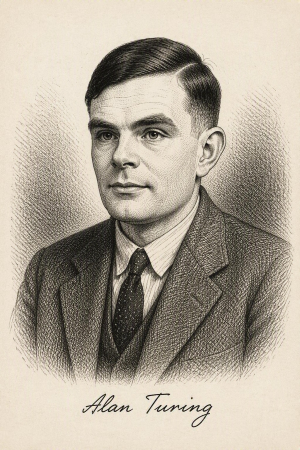
Turing’s theories provided the foundation for modern computers, while his efforts during World War II helped change the course of history.
Early Life and Education
Alan Mathison Turing was born on June 23, 1912, in London, England.
From a young age, Turing showed exceptional talent in mathematics and logical reasoning. He studied at King’s College, Cambridge, where he gained recognition for his work in mathematical sciences.
Later, he continued his studies at Princeton University in the United States, earning a doctorate in mathematics.
The Turing Machine
A Revolutionary Idea
In 1936, Turing introduced the concept of the Turing Machine, a theoretical computing device capable of following instructions to solve mathematical problems.
Although it was not a physical machine, it established the principles behind programmable computers.
Key Concepts
- Program execution
- Data storage
- Algorithm processing
- Logical operations
- Computational theory
Today, the Turing Machine remains one of the most important concepts in computer science.
World War II and Codebreaking
During World War II, Turing worked at Bletchley Park, Britain’s secret codebreaking center.
His team focused on decoding messages encrypted by Germany’s Enigma Machine, which was considered nearly impossible to crack.
Contributions
- Developed advanced codebreaking techniques
- Designed machines to analyze encrypted messages
- Helped Allied forces gain critical intelligence
- Shortened the war by providing strategic information
Many historians believe Turing’s work saved countless lives and significantly accelerated the Allied victory.
Contribution to Artificial Intelligence
Alan Turing was among the first scientists to ask a revolutionary question:
“Can machines think?”
This question led to the development of modern artificial intelligence.
The Turing Test
In 1950, Turing proposed what became known as the Turing Test.
The test evaluates whether a machine can exhibit intelligent behavior comparable to a human.
Even today, the Turing Test remains one of the most influential concepts in AI research.
Building Modern Computing
Turing contributed to the design of some of the earliest electronic computers.
His ideas helped establish:
- Computer programming
- Software development
- Algorithm design
- Data processing
- Artificial intelligence research
Modern computing systems continue to rely on principles first described by Turing.
Challenges and Recognition
Despite his extraordinary achievements, Turing faced significant personal and professional challenges during his lifetime.
Many of his contributions remained classified for years because of wartime secrecy.
Over time, governments, universities, and technology organizations recognized the importance of his work.
Today, he is celebrated as one of the most influential scientists in history.
Legacy
Alan Turing’s influence can be seen throughout modern technology.
Lasting Contributions
- Created the Turing Machine concept
- Helped break the Enigma code
- Laid the foundations of computer science
- Pioneered artificial intelligence
- Influenced generations of scientists and engineers
The prestigious Turing Award, often called the “Nobel Prize of Computing,” is named in his honor.
Alan Turing at a Glance
Full Name: Alan Mathison Turing
Born: June 23, 1912
Birthplace: London, England
Died: June 7, 1954
Nationality: British
Profession: Mathematician, Computer Scientist, Cryptanalyst
Known For: Turing Machine, Enigma Codebreaking, Artificial Intelligence
Title: Father of Modern Computing
Famous Quote
“We can only see a short distance ahead, but we can see plenty there that needs to be done.”
— Alan Turing
Conclusion
Alan Turing transformed the world through his pioneering work in computer science, cryptography, and artificial intelligence. His revolutionary ideas established the foundation for modern computing and continue to influence technological innovation today. As the Father of Modern Computing, Turing’s legacy lives on in every computer system, software application, and AI technology used around the world.
5 thoughts on “Alan Turing: Father of Modern Computing”